quantum vis

as much as you please…


Leave a comment

Green Card Dreaming

greencard-3

Do you remember the film Green Card, about a New York horticulturist who marries a Frenchman?

They were virtual strangers and the union was one of convenience. It allowed him to obtain a Green Card and for her to live in a beautiful apartment where the body cooperate demanded residents be married.

Green Card stared Andie MacDowell and Gérard Depardieu.

For me, the real star of the film was the conservatory attached to Andie MacDowell’s apartment.

I can understand why she married a virtual stranger for this apartment and its glorious conservatory.

At the rear of the conservatory was an exquisite Italianate wall fountain.

It was a simple fountain, bordered by an arch of weathered cream bricks and backed with a distressed wall decorated in a checkerboard pattern.

Water fell gently from a modest tap into a shell shaped bowl and then into a small semicircular fishpond. The sound created by its lightly cascading water was tranquil but unobtrusive.

How I covet that fountain, I don’t know how many times I have paused the movie just to have a close look at it.

Sadly, I don’t have a fountain in my garden, but if I did it would be just like the ‘Green Card’ one.

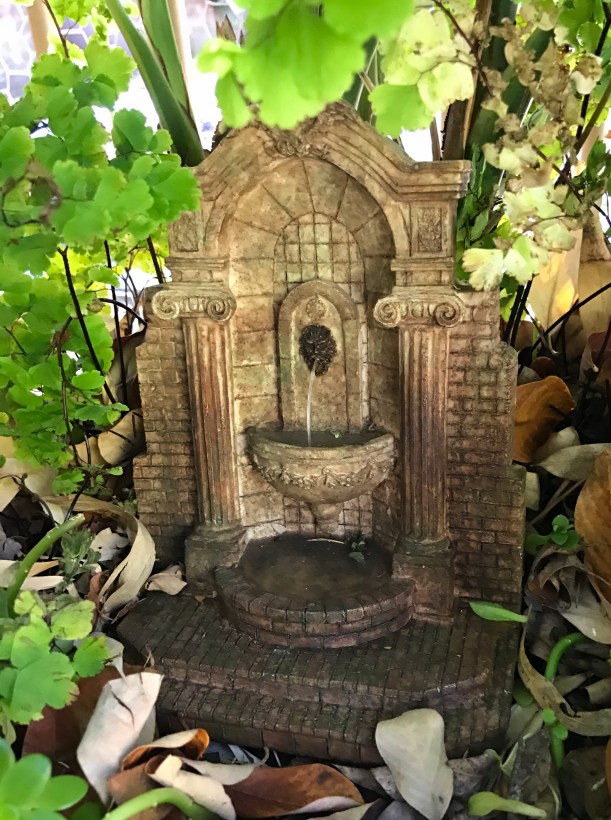
Instead I have made do with a miniature fountain which I have placed in a pot of maidenhair ferns, here is a photo. Look a little similar?

I call it my ‘Green Card Dreaming Garden.’

Maybe one day I will have an Italianate wall fountain but in the mean time I will just have to watch the movie and dream.

I hope the pause button on my remote continues to work.

JT


1 Comment

Constance Spry

With Christmas coming I need to refer to my copy of ‘Constance Spry’s Cookery Book’-for seasonal recipes such as Christmas cake, plum pudding and ham glaze.

It was first published in 1956 and has since become a cook’s bible.

Constance Spry was an extraordinary woman. Born in 1886, she became a lecturer for the Irish Women’s National Health Association after studying hygiene, physiology and nursing.

At the beginning of WW1 she was secretary of the Dublin Red Cross. Constance then continued her war effort in England becoming head of women’s staff at the Ministry of Aircraft Production.

A period as a leading women’s educator followed when she oversaw the education of factory girls in London’s East End.

In 1929 she opened a florist shop which became fashionable, creating floral arrangements for royal weddings and the Queen’s coronation.

Constance Spry then established a domestic science school in 1946 and wrote her famous cookery book with Rosemary Hume.

One of her many interests was cultivating old varieties of roses. She brought the antique style of roses back into fashion. In 1961, a young rose breeder called David Austin honoured her with his first commercial rose by naming it, Constance Spry.’

The photographs show ‘Constance Spry’ roses rambling up a large Ironbark tree in my garden.

I can’t decide which is more pretty; the extravagant pink blooms or the perfect tight buds which are a deeper shade of pink.

All these years after her death in 1960, the remarkable Constance Spry still enriches our modern gardens and kitchens.

Now let me see, which page has her recipe for brandy butter?

JT


Leave a comment

My Wager

my-oak-trees

“Tree planting is always a utopian enterprise, it seems to me, a wager on a future the planter doesn’t necessarily expect to witness.” ― Michael Pollan, Second Nature: A Gardener’s Education

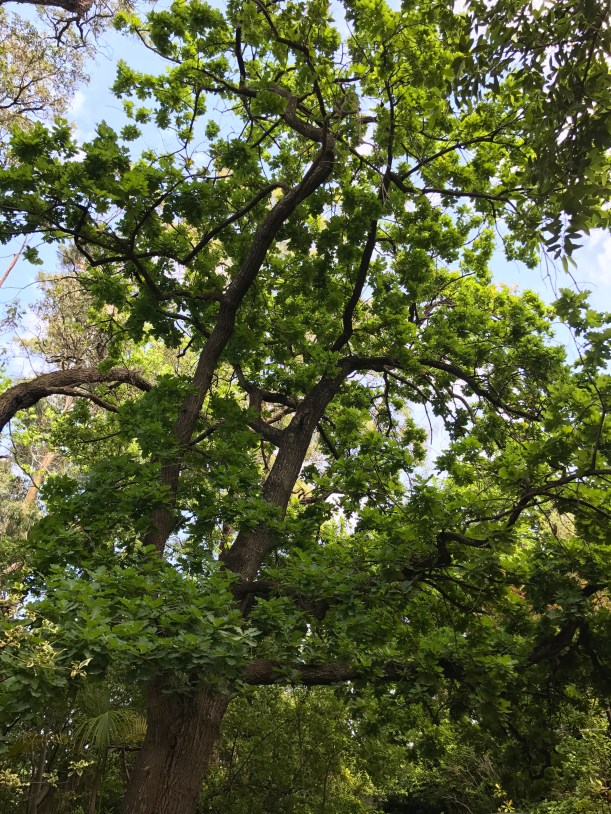
I am grateful for those who gardened before me and planted the lovely oak trees which I now enjoy in my garden. This is a photo of one of my beautiful oaks.

By my estimate, the oak trees are 70 years old; that’s still young in the life of an oak.

I understand they were planted from acorns collected by the family who built my house. The children of the family collected acorns from mature trees in a local park ,which was established in 1861.

So the original trees were about 85 years old when the acorns were collected. It was a wonderful thing for the family to have done.

Now it’s my turn to contribute and plant trees; I only wish I had started sooner.

I’ve planted some ginkgo trees which are slow growing so I don’t expect to see them grow into maturity.

Like the children before me, I have collected seeds from older trees.

In my case, I collected cones from two Cedrus Deodara (aka Himalayan Cedar or Deodar Cedar) growing in our local Botanic Gardens.

These majestic trees were probably planted in 1869 and they appear to be approaching the end of their lives. Because of their age the two Deodars are heritage listed.

I’ve distributed the cones throughout my garden in the hope they will germinate and grow.

Perhaps my garden can preserve their precious botanical DNA for future generations.

Let us hope those Deodar cones germinate and flourish like the acorns did all those years ago.

JT


1 Comment

For the Love of Edna


vista-4I secretly stalk other people’s gardens.

I lurk around gardens which I admire, looking in while loitering on the footpath.

Sometimes I can only view them from the road way, so I slow the car down and crawl past to get a jolly good look.

This habit started in my childhood when I became obsessed with one particular garden behind a high fence.

I caught my first look into it when sitting on a school bus, the elevation of the bus allowed me to view over the fence and I fell in love.

Every time I boarded that bus I chose a seat which gave me the best view of this garden.

Later, I learnt one of Australia’s most eminent garden designers, Edna Walling created the garden during the 1920s.

As an adult I have become a dedicated Edna Walling fan, visiting many gardens she designed as well as reading her books and articles.

She preferred foliage and limited the colours of her flowers to white or soft pastels.

It is the garden vista which is her statement.

Edna Walling’s trick was to create a garden focal point to catch the eye.

Sometimes grand but often simple these vistas invite one to linger and enjoy the view a little longer.

It is as if she has sculpted the essence of peacefulness in her gardens.

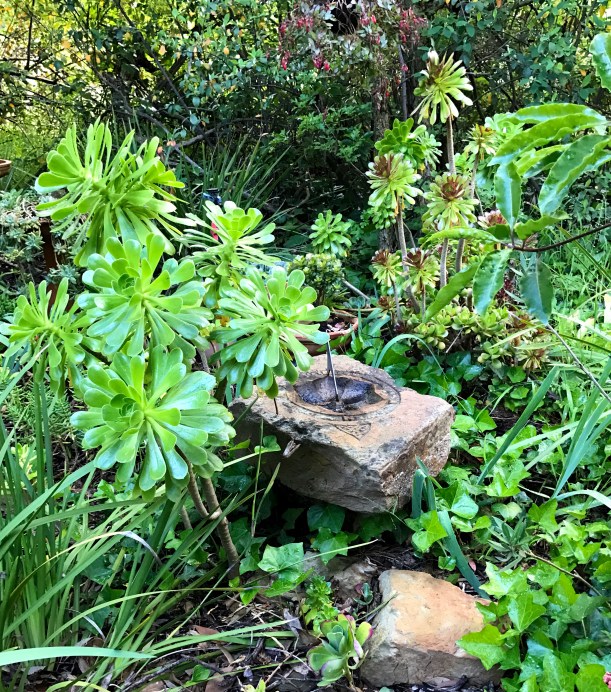
This photograph shows one of my attempts to emulate Edna.

I still drive past the original Edna Walling garden I saw when I was a girl on the bus, but alas I don’t get the same view from the car.

Perhaps it’s time to hang up my car keys and get back on that bus.


JT


Leave a comment

Foxgloves

Have you ever wondered what sort of toxin coated the poisoned arrow tips in ancient warfare?

It was a deadly toxin derived from the beautiful foxglove plants which are favourites in many of our gardens today.

Every section of this sweet plant is poisonous.

Foxgloves are named for their unusual tubular flowers which resemble gloves. The charming little ‘gloves’ grow on tall handsome spires.

They are a biennial and prefer a rich well-draining soil. They happily self-seed but will only flower in their second year.

Botanically, foxgloves belong to the Digitalis genus.

The term digitalis is also used for the modern day drugs known as cardiac glycosides, which were developed from the toxic component of foxgloves.

These drugs increase the contraction of the heart, and therefore increase cardiac output. Cardiac glycosides treat congestive heart failure and cardiac arrhythmias. The most well-known example is the commonly used drug, Digoxin.

So our pretty garden foxgloves have been both a menace and saviour to mankind.

Here are some photos of foxgloves growing in my garden.

JT


Leave a comment

Blue and White in the Garden

Why do we love blue and white pottery? Perhaps because they are the natural colours above us-blue for sky and white for clouds. Therefore, the colour combination seems significant to us.

For centuries blue and white ware has been popular in various cultures.

Blue and white porcelain went into mass production in China during the 14th century supported by importation of cobalt blue pigment from Persia. The early blue motifs were often Persian in nature and when combined with Chinese fine white porcelain the elegant blue and white ware we know today was created.

During the 17th century the Chinese exported to Europe where blue and white pottery was in great demand. However, the Chinese rebellion in the 1640’s destroyed many kilns and the production moved to Japan for about 100 years until the Chinese manufactures recovered.

The Dutch, in Delft, began to manufacture their own blue and white tin glazed ware from about 1640. By the 18th century other Europeans began to produce their own blue and white ware and so Chinese imports into Europe diminished.

The popular willow pattern is an entirely English design from the late 1800s.

I adore blue and white pots and have many in my garden. I tend to group them together to enhance the effect. I purchase them from a variety of stores but many I find in my local China Town where, with astute bargaining, I buy at a sound price.

Here are a few examples of the blue and white ware in my garden.

JT


Leave a comment

Garden Statues


Statues help emphasise particular sections of a garden. They do this by drawing the eye, helping us focus on a particular view by creating a point of interest; a focal point.

The eye is drawn, and without realising it one is looking more deeply at the garden, subconsciously taking greater notice of the environment. Our attention is held, and our curiosity is intensified.

I like to place statues in my garden to give an element of surprise. When a visitor comes across a statue hiding amongst the foliage, it delightfully reveals itself in a playful manner.

I prefer beauty in the garden, so my most important rule is statues should pleasing to the eye and have an element of charm.

JT


Leave a comment

Rock n Roll Blooms

best-rock-n-roll-blooms

I once knew a conservative vicar with an unusual obsession.

He took me into his confidence when I sat next to him at an Easter luncheon one year.

The vicar recently had attended a conference in the US and afterwards stayed on to holiday in America. I asked him what was his favourite spot in the USA.

Surprisingly he said, Graceland, home of the late Elvis Presley in Memphis, Tennessee.

I hadn’t realised this quiet man of the cloth was a huge Elvis Fan.

Throughout lunch the vicar entertained me with descriptions of Graceland and of his extensive Elvis Presley record collection.

Oddly this reminded me of my collection of succulents.

Like the vicar, succulents have a conservative quietness for most of the year but do show a truly surprising aspect.

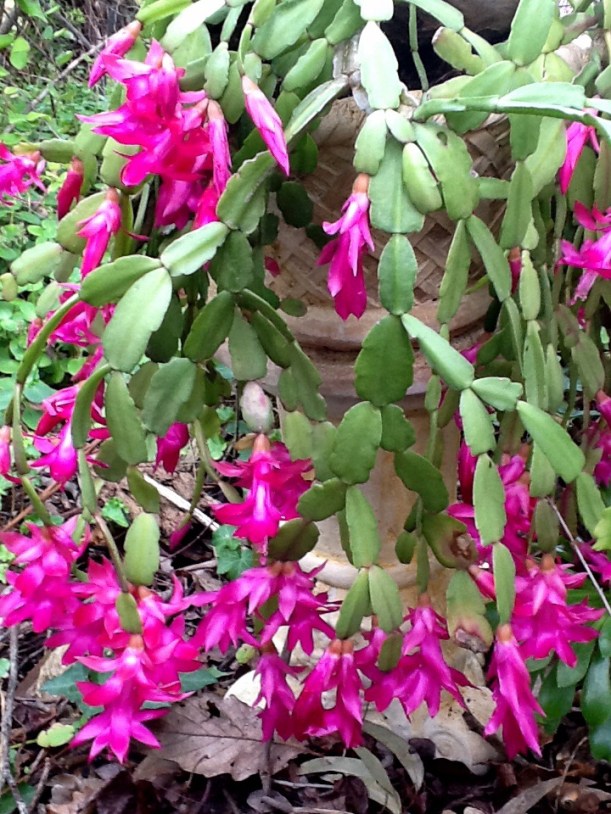
When succulents bloom they reveal their wild side and produce bright dynamic flowers, stronger in colour and bolder than most others in the garden.

I like to call them Rock n Roll Blooms.

One day the succulent is growing quietly in your garden and the next they can be sporting  brazen flowers of astonishing colours.

The colour of these blooms in the photograph is superb, it’s a blistering hot pink.

I think they are as flamboyant as Elton John’s costumes, as striking as Beyoncé on a red carpet and as electrifying as Pink herself.

So you see, with such flashy, crowd pleasing flowers, this is why I call them Rock n Roll blooms.

What became of the rock n roll vicar? He eventually became an eminent Bishop and I smile to think of Elvis Presley’s ‘Blue Suede Shoes’ rocking the halls of his Bishop’s Court.

JT


Leave a comment

Weeds or Flowers?

oxalis

Winnie-the-Pooh’s melancholy friend Eeyore is often quoted as saying ‘Weeds are flowers too, once you get to know them.’

The line was actually written by Disney Inc. for Eeyore in one of its animations.

I am not a fan of the Disney makeover of Winnie-the-Pooh. I prefer the original books.

A. A. Milne first began to create the characters, stories and poems in 1924. E. H. Shepard superbly illustrated Milne’s innocent narratives with simple pen and ink drawings.

Together they only produced four modest books – ‘Winnie-the-Pooh’ and ‘The House at Pooh Corner’ as well as two volumes of children’s verse, ‘When We Were Very Young’ and ‘Now We Are Six.’

The books told light hearted stories and poems from the point of view of the child, often featuring a menagerie of toys and their owner Christopher Robin.

I first got to know Winnie-the-Pooh by reading my father’s boy-hood copy, of ‘When We Were Very Young.’ It is a well-read scruffy edition with a faded blue fabric cover. Three generations of children in our family have enjoyed it.

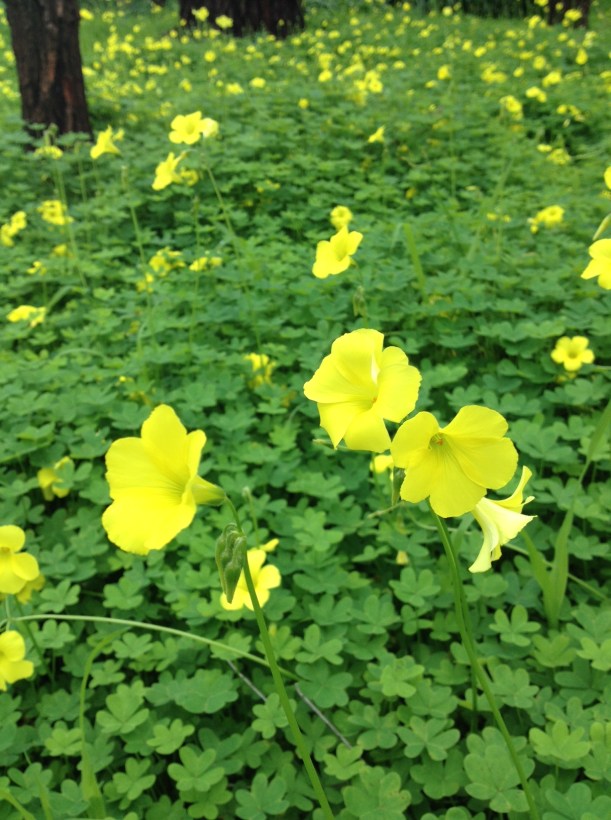
This photograph shows my bottom garden which is overrun with the invasive weed, oxalis. Sometimes known as wood sorrel it has a pretty yellow flower and lush green leaf. Oxalis is virtually impossible to eradicate due to its tuberous root system which can lay dormant in the soil for years.

There is not much I can do about it so I have decided to live with the oxalis and enjoy my cheerful meadow of yellow flowers.

The original Eeyore may not have actually said it, but I do agree… weeds are flowers too.

JT


Leave a comment

The Arum Lilies, a short story

white-arum-lily-image

It was spring in the farming hamlet of Greta, and Martha sat on her veranda unpicking an old wedding gown. It was soft white muslin, delicately woven to ensure the garment was gentle on the bride’s skin. ‘Such beautiful and sacred fabric,’ thought Martha.

The frock was not Martha’s own wedding gown; she purchased it from her neighbour, Kate Kelly. It had been Kate’s late mother’s wedding dress, and as Kate was now an elderly spinster, it was of no use to her. Times were hard on Kates’s farm so selling the gown helped make ends meet. Martha had been kind to the Kelly family when others in Greta had not, so Kate thought her mother would approve of Martha buying the wedding gown.

Martha planned to use the fabric to sew a new Sunday school dress for her daughter, Violet. She decided to smock the front with pale pink thread and place a ribbon sash of the same shade around the waist. When Violet’s pretty new dress was finished Martha was particularly pleased.

There was a length of the pink ribbon left over so Martha, knowing how hard life was for Kate, took it to the old women’s humble cottage. Martha suggested the pink ribbon would look lovely on Kate’s straw hat and the old lady agreed, so Martha carefully stitched the ribbon onto the hat.

Delighted, Kate declared, ‘The new ribbon on my hat looks lovely and Violet’s new dress is so sweet. My mother would be smiling from her grave to see her wedding gown being put to such good use.’

‘Yes, I am sure she can see it from up there. The view from the back hill is wonderful, so your mother will be able to see Violet coming and going from Sunday school,’ added Martha. She was referring to the position of Mrs Kelly’s grave which was high on a hill in Kate’s back paddock.

Life had been hard for old Mrs Kelly, she was widowed early and her two sons had been in serious trouble with the law. One died in a fire and the other was hanged from the gallows for his crimes. With the Kelly boys dead only Mrs Kelly and Kate were left to farm their unproductive, swampy land. Mrs Kelly and Kate were gentle, law abiding souls but the locals ostracised them because of the Kelly boy’s bad reputation. Life was lonely for the two Kelly women. Martha was their only visitor and she was warmly appreciated.

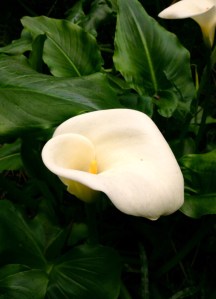
Once old Mrs Kelly died Martha continued to look in on Kate. One day, during a particularly wet spring, Martha set out to visit Kate and, finding her regular route across the paddocks blocked due to the boggy conditions, she took a different path on higher ground. In an isolated back paddock Martha came across a patch of white arum lilies growing in the wet ground. They looked splendid, if a little strange out in the middle of nowhere. Martha picked a bunch for Kate.

The old woman was pleased to see Martha but became uneasy when she produced the arum lilies. ‘The paddocks were so boggy that I came a different way and I discovered these and thought a bunch would brighten your cottage,’ Martha explained.

A look of apprehension came across Kate’s face, like a shadow. ‘Oh dear, they are Elizabeth’s lilies,” she confessed, her voice trailing off.

Martha was confused. ‘Who is Elizabeth?’ she asked.

‘It happened years ago,’ explained Kate. ‘A child went missing one night from her home in Glenrowan – young Elizabeth Banks. The men of the district searched for her and never found her. One day, Mother and I were chasing a stray lamb on a remote part of the farm and we came across her. Her decomposed body lay huddled beside a tree in her tatted nightgown. Elizabeth had been dead for years.’

Martha’s blood ran cold. She recalled the local mystery of the missing girl, Elizabeth Banks. The child had never been found.

Kate whispered, ‘When we found her body, Elizabeth’s parents had long since left the district. Mother was terrified the police would blame her for Elizabeth’s death; they had been keeping an eye on us since my brothers’ troubles. So we decided to give her a decent burial where she’d been found. We prayed for her and planted the lilies on her grave.’

There was silence. Martha understood the unusual and precarious situation the two Kelly women found themselves in. Martha gently said, ‘I guess there was nothing to be done, if you found her dead and her parents were long gone. You gave her a good burial.’

Tears flooded Kate’s eyes, she admitted carrying the secret had been a burden.

Kate disclosed, ‘In my dreams I can see Elizabeth dressed in her white nightgown, dancing around the lilies. Sometimes when the night is still and clear I even think I can hear her singing.’

Martha began to cry as well and embraced Kate. She promised, ‘I will never say anything. It happened so long ago. Best let little Elizabeth rest in peace.’

When Kate Kelly eventually died she was buried on the hill beside her mother. Martha grew old herself, but in all the years she never revealed the secret of the lost girl’s grave.

Her daughter Violet, grew into a fine young woman, married and moved away from Greta.

Some years later in early spring, Violet returned to Greta with her husband and their young daughter, Grace. Violet dressed her little girl in the same muslin dress which her mother made all those years ago. Martha was delighted to see her granddaughter wearing the dress she had reworked from Mrs Kelly’s wedding gown.

The family took tea on the veranda. Little Grace sat quietly with the adults and eventually Martha allowed her granddaughter to leave the table and play in the garden.

Grace played under the lemon tree until a marmalade cat caught her eye. She followed it around the side of the house, through the orchard and into the dairy. Under the dairy sink Grace discovered the cat had a litter of kittens, excited, she sat to watch them.

While the kittens tumbled and played, Grace became aware of what sounded like a child singing. Peeping out the back door of the dairy she saw a little girl near a distant mulberry tree.

Keen to investigate, Grace was soon under the mulberry tree but the girl was no longer there. Then Grace saw her in a distant paddock, she was dressed in a white threadbare nightgown and her skin was so pale it appeared translucent.

Each time Grace came closer the mysterious white girl would appear a little further away. Before long Grace had crossed many paddocks trying to catch up, forgetting about her parents and grandmother back at the homestead.

Presently, the white girl turned toward Grace and called ‘Come and see my flowers. I’ll let you pick some.’ Grace replied, ‘I’d like that very much.’ Soon the two girls stood looking at each other across a bed of crisp white arum lilies.

‘Where is your mother and your house?’ asked Grace.

“I don’t have a house or a mother but I do have these lilies,” replied the white girl. Then, staring at Grace, she added, ‘You have Mrs Kelly’s wedding dress on.’

‘No I don’t,’ Grace replied indignantly. ‘It’s my dress and it belongs to me, my grandmother made it.’

The white girl responded, ‘Well, Mrs Kelly told me it was her wedding dress.’

Grace was confused now – what is she talking about?

‘If you are wearing a wedding dress then you must carry some flowers. Go on, please pick some,’ insisted the white girl.

Grace was proud the white girl thought her dress smart enough to actually be a wedding dress. She began to think some flowers would be nice and perhaps make the white muslin dress, tied at the waist with a pink ribbon, look more like a wedding gown.

Grace’s hand reached toward a succulent green stem of one of the lilies.

Suddenly, a wrinkled old hand firmly grasped Grace’s wrist and pulled it away. Grace was startled to see an old lady in a straw hat. Oddly, a ribbon on the hat was the same colour as Grace’s sash.

‘Elizabeth can’t play anymore,’ the old lady gently explained, ‘and you must go back to your grandmother.’ With that, the old lady took Grace by the hand and led her across the paddocks. In time, the mulberry tree appeared in the distance and the woman told Grace to run towards it.

Grace’s grandmother saw her and ran out of the dairy towards the mulberry tree. ‘Where have you been? We have searched everywhere,’ cried Martha.

‘I went to see Elizabeth and her flowers, and a nice old lady with a pink ribbon on her hat brought me back.’

Martha’s heart beat fast as her frail eyes scanned the paddocks. There was no one there.

But on top of the hill where Kate and Mrs Kelly were buried, Martha thought she could see three figures; they appeared to be two old ladies, one wearing a hat and with them stood a young girl dressed in white.

JT